
This post focuses on reflection and action. These are parts of the 4 key principles to strengthen our connection with Nature. To reiterate, the four principles are
- stillness/silence
- observation
- reflection
- action
Having been back from spending a week in Glen Affric recently, I hope to share some insights from the experience. Before I go on, I need to give some context and background for my week in Glen Affric.
Colonised nature & green spaces
While nature is all around us and we are a part of her, the environment we are in is highly regulated. Our gardens are neat and tidy, with manicured grass and flowers in garden beds. Our parks are likewise planned and curated. As my guest contributor, Umar, wrote about the sidewalk, linked here,
A tamed, natural beauty. Not unlike the trimmed hedges and carefully managed flower beds of colonial botanic gardens.
and
Sidewalks just like these colonial gardens express beauty as an expression of ordering power. Sidewalks are a site for a highly ordered, docile and ‘drawn within the lines’ greenery. Much in the same vein of Fanon’s description of colonised world as a “compartmentalized world”,2 the ‘drawn within the lines’ nature of sidewalk greenery express the colonial power’s capacity to order and consciously keep grass and greenery within the desired distribution of the sensible determined by the colonial gardener.
Our green spaces are always kept within boundaries and held in check as to where things can grow. I cringe at the expression “mowing the grass” because of its violent connection to Israel’s military operations in Gaza over the years. Thinking about the plants that have been physically mowed, what impact are our actions having on them? Most of us are not aware of the abuse and trauma we are inflicting on our fellow sentient beings.
Rewilding
But that awareness is growing and today it is taking the form of “rewilding.” What is rewilding? There are different definitions such as
At Rewilding Britain, we define rewilding as the large-scale restoration of ecosystems to the point where nature is allowed to take care of itself. Rewilding seeks to reinstate natural processes and, where appropriate, missing species – allowing them to shape the landscape and the habitats within. It’s focused firmly on the future although we can learn from the past.
Rewilding Britain
Or
Rewilding is comprehensive, often large-scale, conservation effort focused on restoring sustainable biodiversity and ecosystem health by protecting core wild/wilderness areas, providing connectivity between such areas, and protecting or reintroducing apex predators and highly interactive species (keystone species).
Rewilding.org
But the way I define rewilding is restoring balance in nature, including us. Through the spread of capitalism, we have colonised and over-exploited the Earth that there is systemic imbalance in the world. This imbalance has led to not only the climate crisis but loss of biodiversity and wide spread pollution. It has also led to the break down of communities and social cohesion.
For me, rewilding is taking responsibility to address the imbalance in ourselves, our community, and the land. It is both an individual and a collective responsibility. That is why I have been volunteering for the past three years with Trees for Life. It is the reason for my being in Glen Affric for a week last month.
Sacredness of Virgin Forests
Rarely do we get a chance to interact with ancient and virgin forests, relatively untouched by our activities. There is something really special about these places that I’ve not felt in other nature parks. It is that sense of sacred, of God’s presence. My theory is that these places are where God’s remembrance has never stopped.
I have been blessed to visit these places and experienced that sacred presence several times in my life. From the jungles of Malaysia to the temperate rainforest of Tasmania. And now to the ancient Caledonian Pine Forest of Scotland at Glen Affric as shown in the photo below.
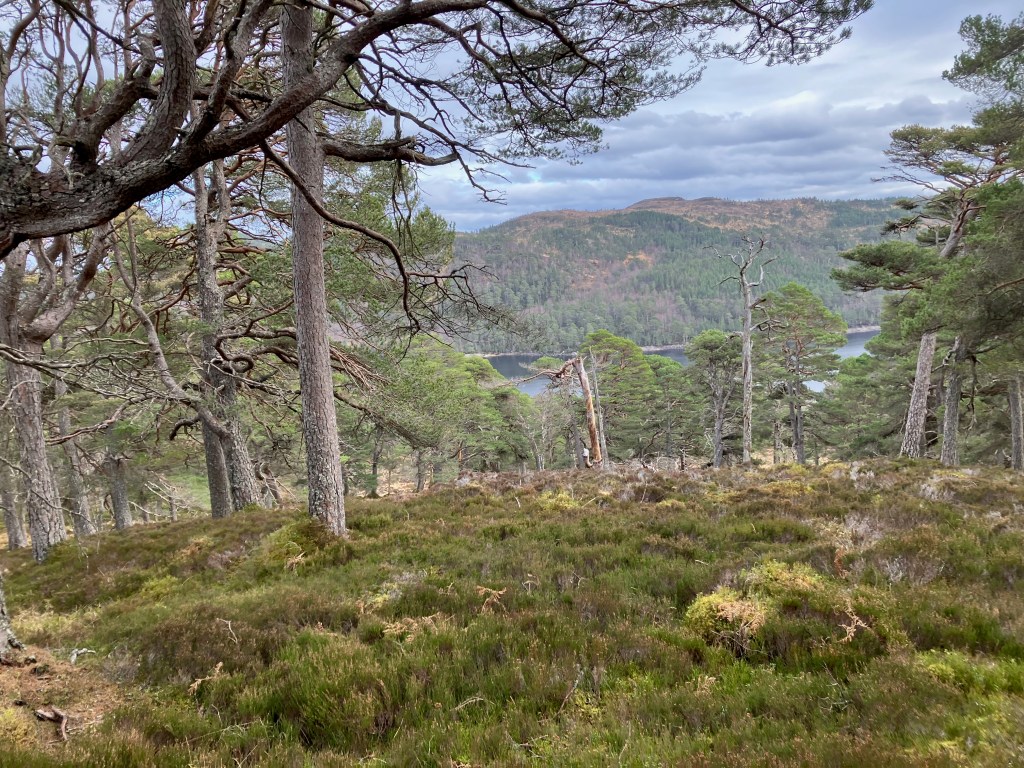
The first time I was in Glen Affric was in Ramadhan 2023. The connection to the land and God that I felt then had a great impact on me. I remember praying amidst the calls of the meadow pippits in the afternoon and the owl calls at night. But it was the granny pines that captured my heart. The Scots pines can live to 500 year old or even older. The older they grow, the more gnarly they become adding character to the landscape. The Caledonian forest is an open canopy forest made up by tall Scots pines. There are deciduous trees ranging from aspen to montane species of birch and willow. The wild berries like blaeberries, wild raspberries, bearberries are some of the undergrowth of the forest.
But most of Glen Affric is bare due to the felling of trees for timber historically. And the forest struggles to regenerate because of the ever increasing number of deer in the area. Still there are such rich biodiversity in Glen Affric as shown in my video below of a few of them.
And of course, the melodic voice of the land is expressed through the sound of water moving through the glen. I was privileged to hear snippets of the song as I walked the length of the glen. Below is a compilation of those snippets.
Rewilding the land
Over 30 years ago, Trees for Life (TFL) volunteers helped fenced a small area of the forest struggling to regenerate. Today, that small enclosed part of the forest is teeming with trees of different species and age. And it has a healthy undergrowth. All because the fence kept the deer out. That is an example of a simple action to restore the balance and rewild the land.
These past few years, the Forest and Land Scotland has enclosed large areas of Glen Affric off. They also reduced the number of deer in the area through culling. And Trees for Life has been active planting native species in Glen Affric over the years. This year, my group has the pleasure of planting in these newly enclosed areas. Below is a video of our last day of planting. We were up high, planting montane species of willow and birch.
As our guide Dominic said, we are really planting seeds of the future as some of these saplings will survive to self seed. In fact, over the years I have volunteered here, I have found many self seeded saplings. It underscores how nature is resilient if balance is restored.
We also build more fences to protect the trees growing in the riparian area, i.e. near or on the river bank. These were areas that had not been fenced by Forest and Land Scotland. However, trees on the river bank are really vital to the health of the river. So we did what we could. Below is a video of what we built.
Reflecting on my experience
The week was also about rewilding myself in the sense that I needed to find my balance again. Especially after a bewildering year where I have felt helpless, watching children being killed by Israeli bombs and starved because of aid blockades. All the while going on with my day to day activities.
As I mentioned at the beginning, I felt that strong connection to God and nature in Glen Affric. Not only was I surrounded by mountains, rivers, forests, and more, I was also cut off from technology for the most part. There was no wifi or phone signal anywhere in the Glen.
Going back to the four key principles of
- silence/stillness
- observation
- reflection
- action
I was encompassed by the silence achieved through being cut-off from our busy modern world. In that silence, the voices of other sentient beings like the mountains, rivers, lichens, insects, and more came through. I was able to use all of my senses to observe them without distractions.
In the photo below, I was standing in a wee hillock looking at the surrounding mountains. It gives us perspective on how tiny we humans are as compared to the beautiful mountains surrounding us.

I remember that day on the hillock, listening to the river and the birds, and thinking about the verses from Surah An-Nazi’at 79:27-33
ءَأَنتُمۡ أَشَدُّ خَلۡقًا أَمِ ٱلسَّمَآءُۚ بَنَٮٰهَا (٢٧) رَفَعَ سَمۡكَهَا فَسَوَّٮٰهَا (٢٨) وَأَغۡطَشَ لَيۡلَهَا وَأَخۡرَجَ ضُحَٮٰهَا (٢٩) وَٱلۡأَرۡضَ بَعۡدَ ذَٲلِكَ دَحَٮٰهَآ (٣٠) أَخۡرَجَ مِنۡہَا مَآءَهَا وَمَرۡعَٮٰهَا (٣١) وَٱلۡجِبَالَ أَرۡسَٮٰهَا (٣٢) مَتَـٰعً۬ا لَّكُمۡ وَلِأَنۡعَـٰمِكُمۡ (٣٣)
What! are ye the more difficult to create or the heaven (above)? (Allah) hath constructed it: (27) On high hath He raised its canopy, and He hath given it order and perfection. (28) Its night doth He endow with darkness, and its splendour doth He bring out (with light). (29) And the earth, moreover; hath He extended (to a wide expanse). (30) He draweth out therefrom its water and its pasture; (31) And the mountains hath He firmly fixed― (32) For use and convenience to you and your cattle. (33)
In that instance, observing them, I acknowledged that they are more difficult to be created. That shatters the anthropocentric thinking that pervades the modern world and causes so much of the imbalance and injustices.
I admire the mountains who have stood to witness thousands of years of history. This history includes the highland clearances which I think is a type of ethnic cleansing and timber extraction. And yet, still they remain as witnesses. Our lives are fleeting compared to them. Just as they witnessed the injustices and corruption, they also witnessed the flourishing of communities. And as our madness pass, they will stand as witness here too.
Then there is the River Affric meandering through the denuded riparian area, still shaping the landscape. The river make me realise that balance can only be achieved through persistent action. This is evinced by way the river constantly moves through the land, finding different ways to flow. A drop of water from up the mountain travels through the land to join the river. So too each little drop of positive action we take adds to the larger body of positive actions.
Beyond that, their resilience is something we can learn from them. The sand martins made their nests in the sand banks of the river. When these banks collapse, they move to another sand bank, diligently creating their nests again. They will defend their nests as I can bear witness since a pair of sand martin chased me away when I tried to rest near them.
By falling silent, I can hear the sounds and melody of those around me. To me, nature is constantly in motion. The interactions between the various players create the necessary but delicate balance. When one or more of the players disappear or become more dominant, then the balance is shattered. In our age, humans have shattered the balance and we need to restore it.
Act to restore balance
In Glen Affric, the deer population is out of control because the ecosystem is not balanced. They no longer have any natural predators like the wolves and lynx who have been hunted to extinction. Maintaining the balance through fencing is not sustainable. When they removed the fence over an area of the forest that had regenerated, the deer started moving back in. Within a year, there are visible signs of damage to the woodland.
The balance to the ecosystem needs to be restored by reintroducing missing players like the predators and keystone species. As such, I support a campaign to bring back lynx into the Scottish Highlands. You can read it more here. Similarly, by reintroducing the beavers in Glen Affric, it is possible to restore the riparian area. Trees for Life has a write up on the proposal to reintroduce the beavers, linked here.
Let us do our parts to rewild our environment and ourselves. Find that balance within ourselves by being true to our nature.

Leave a comment