
Last year when I went back to Singapore, I found this book “Animals in the Qur’an” by Sarra Tlili. The premise of the book is that it is an eco-centric reading of the Qur’an rather than anthropocentric1. She also looked at other religious traditions briefly where they are also anthropocentric. I found it fascinating because I have always felt that the anthropocentric interpretation of the Qur’an is rather egoistic. The danger of the anthropcentric viewpoint is that we see animals as less than us. That there is a hierarchy of importance with humans at the top. Such views might lead people to treat animal rights as less than human rights. In fact, it is the extreme form of the anthropocentric viewpoint that currently is governing and exploiting the world.
I would encourage people to read the book but I won’t be going into it here. Rather the book inspired me this past Ramadhan to start looking into verses of the Qur’an related to animals. Studying verses of the Qur’an in Ramadhan is a tradition/routine for me that goes back decades. Some of these reflections are culminating in a book I am currently writing called ‘Qur’anic Wisdoms for the 21st Century.’ Hopefully these new research materials will also yield interesting reflections and actions.
Currently, in Islam we have the notion of being a khalifah on the Earth which is translated to be stewardship. If, as we will see in the verses that God is actually in control, what does being a khalifah mean? What impact does it have to our relationship with other creations? I want to bring together my observations and reflections from nature with those from the Qur’an into a coherent worldview. One that redefines our relationship with the natural world through the lens of the Divine.
The Qur’anic verses related to animals and the natural world are not meant for us to take at face value. Instead they are signposts to observe the world around us and derive those meanings and lessons from them. For me, they are prompts for us to embrace our childhood curiosity and explore the vast garden that God has laid out. I remember as a child being amazed by the rubber seeds which can hold on to heat when rubbed. Or that potatoes had eyes. Or that giving birth to kittens is a bloody mess.
Where to start? I could have focused on the well known animal stories but I want to establish the foundation of the Qur’anic narrative about animals. So I have chosen to start with the general term for animal in the Qur’an, دَابَّةٍ. It comes from the triliteral root dāl bā bā (د ب ب) in Arabic. The verb of the root dāl bā bā means to creep, crawl, or walk without haste. So the noun دَابَّةٍ means anything that creeps, crawls or walks. In the Qur’an, this term is generally used for any moving creatures including us. We will see later when certain animals or human are excluded from this general term.
One interesting point to note before I start going into the verses is that the term, in its various forms, can be found in all the surahs with animal names except for Al-Fil (The Elephant):
- Surah Al-Baqarah (The Cow)
- Surah Al-An’aam (The Cattle)
- Surah An-Nahl (The Bee)
- Surah An-Naml (The Ant)
- Surah Al-Ankabut (The Spider)
One possible reason for the omission of Surah Al-Fil is one whereby the elephant is being used against God. God knows best.
Communities
Today, I will start with a fascinating verse from Surah Al-An’aam
وَمَا مِن دَآبَّةٍ۬ فِى ٱلۡأَرۡضِ وَلَا طَـٰٓٮِٕرٍ۬ يَطِيرُ بِجَنَاحَيۡهِ إِلَّآ أُمَمٌ أَمۡثَالُكُمۚ مَّا فَرَّطۡنَا فِى ٱلۡكِتَـٰبِ مِن شَىۡءٍ۬ۚ ثُمَّ إِلَىٰ رَبِّہِمۡ يُحۡشَرُونَ (٣٨)
although there is no beast that walks on earth and no bird that flies on its two wings which is not [God’s] creature like yourselves: no single thing have We neglected in Our decree. And once again: Unto their Sustainer shall they [all] be gathered. (Surah 6:38)
Here the Arabic word translated as creature above is أُمَمٌ which is the plural of ummah. Lane’s Lexicon2 defines ummah as a nation, a people, a family of living beings. i.e. communities. This idea of each being, like the deer or the grasshopper, as communities is echoed by Indigenous religious traditions. They see animals as non-human persons and their kin, calling them ‘Brother.’
Before I go further, I want to note that in the previous verse, i.e. Surah 6:37
And they say, “Why has no miraculous sign been bestowed on him from on high by his Sustainer?” Say: “Behold, God has the power to bestow any sign from on high.” Yet most human beings are unaware of this (37)
God discusses about miraculous signs that we are ignorant of. My understanding is then these communities of non-human people are among His signs. Sayyid Qutb3 in his exegesis/tafsir wrote
All animals that walk on earth, be they insects, reptiles, or vertebrates and all flying creatures, including every winged insect or bird, and indeed every living creature, belong to a community which shares certain characteristics and a particular way of life, just as human beings do. God has not left any type of His creation without providing it with an elaborate plan to organize its existence and without taking account of what it does with its life. At the end, all creatures are gathered to their Lord for judgement.
This short verse, which makes an all-important statement about life and the living, has a strong effect on our hearts as it describes God’s complete supervision, elaborate planning, total knowledge and superior power.
That is the thrust of this verse; all animals are just like us. God has created them with a purpose and provision. And like us, they too will return to God. Al-Kashani4 and Shafi5 in their exegeses, based on some sayings of the Prophet s.a.w., also agreed that animals too will face their own judgement on that Day. It shows that the rights of every living creature is important to God. In that, there is an equitable sense of justice. There can be no violation of a person’s rights, human or otherwise.
Beyond this right of each person is the concept of communities. We seldom think of animals as forming communities, exclusively thinking it as a human trait. Maybe animals form family groups like a pride of lions or wolf packs but a community is more than that. It has elements of
- shared identity and sense of belonging
- good communication and shared values
- joint action
The Qur’an is stating that animals too form communities with similar levels of commitment to those communities.
The Humble Earthworm
Let us reflect on the humble earthworm as an example of a community. So why have I chosen the earthworm? Because they are often overlooked. Many of us don’t even notice them as we step on them or run over them with our bikes. But do you know that the presence of earthworms is a sign of a healthy soil?
I find earthworms fascinating and often think that they are either very brave or suicidal. On my walks, I often come across them crawling on their bellies, trying to cross the pavements/paths. Some successfully cross but others are killed by people stepping on them or bikes running over them. Yet more die because of the loss of moisture on sunny days. I try to save them whenever I come across struggling earthworms.
There are around 31 species of earthworms in the UK, some extremely long and others tiny. Earthworms are invertebrates and tend to live either in the ground/soil or under heap of composting materials. I am amazed at how they can appear almost out of thin air once you leave things for composting. In my experience, they love cardboard over food waste. They eat up cardboard so readily. While they are hermaphrodites, they actually mate and lay eggs. Earthworms have no eyes but can sense sunlight. They also have no lungs and breathe through their skin where they need moisture. Once dry, they can no longer breathe. That is why a lot of earthworms die on pavements during sunny days.
Usually when I spot one, there will be more nearby. And during rainy days, so many of them will be crossing the pavement near each other. And I begin to wonder if there is a sense of purpose for their movement. It can’t just be each individual worm deciding to cross on their own. Then I came across this article on BBC, linked here, which describes how earthworms interact with each other:
The earthworms use touch to communicate and influence each other’s behaviour, according to research published in the journal Ethology.
By doing so the worms collectively decide to travel in the same direction as part of a single herd.
and
“I have observed contact between two earthworms. Sometimes they just cross their bodies and sometimes they maximise contact. Out of soil, earthworms can form balls,” says Ms Zirbes.
A modelling study then showed that, by using touch alone, up to 40 earthworms could follow each other in a similar way, explaining how herds of the animals preferred to move together into one chamber in the initial experiments.
“To our knowledge this is the first example of collective orientation in animals based on contact between followers,” the researchers wrote in the journal.
“It is also the first one of collective movements of annelids.”
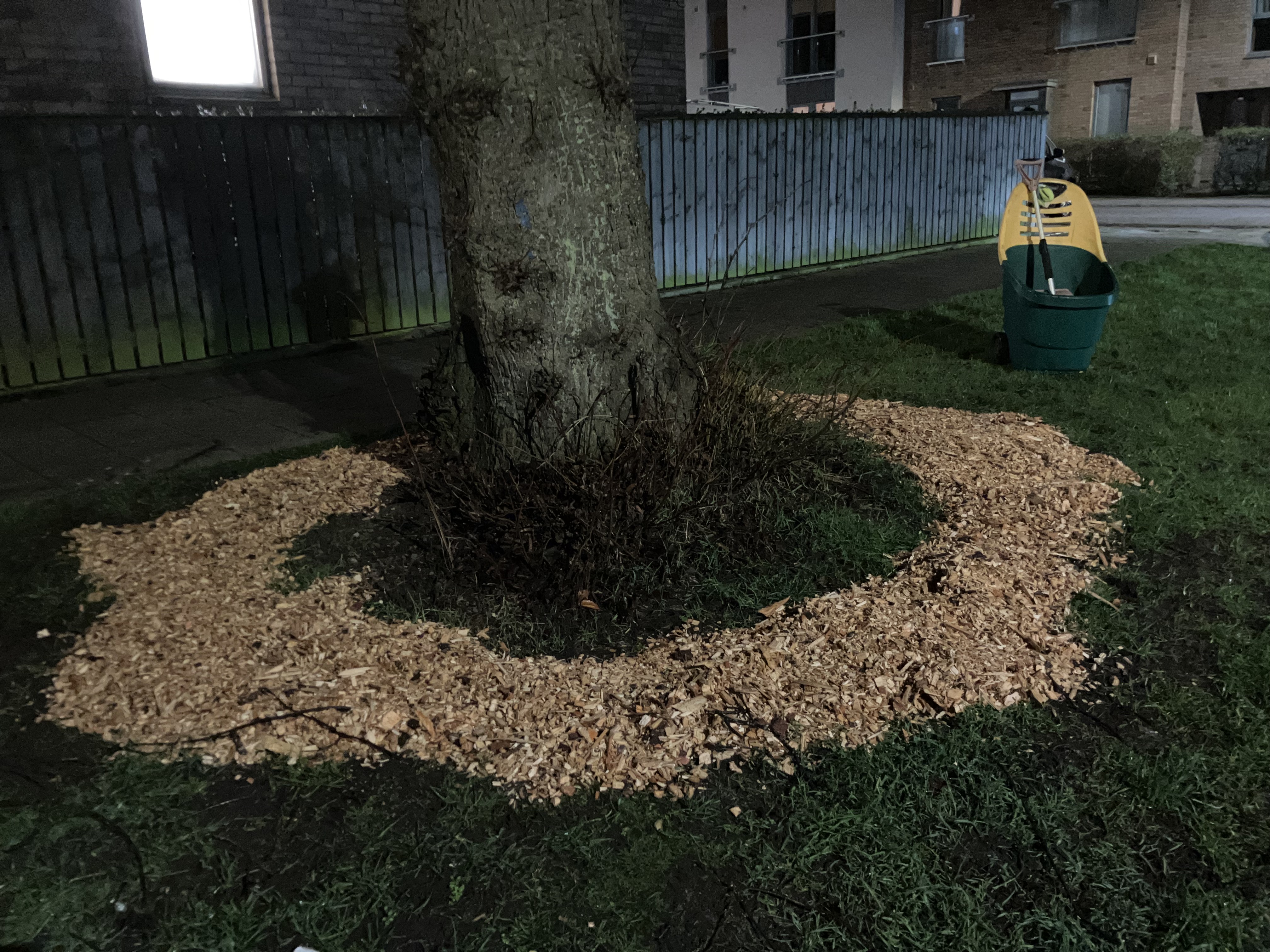
In essence they communicate with each other through touch and work together to make decisions. Decisions such as where food can be found. Recently, I put down mulch around the trees in my area. I got into trouble for it because I didn’t get permission and was told to remove the mulch. When I did, I found several earthworms which I have never seen in the area before. They must have detected the mulch and decided that it was a good feeding place. Below you can find the photo of the mulch I put around the tree and a video of the earthworms that appeared afterwards.
And of course, the number of worms in my compost pile is too many to count. As I say, they love cardboard and paper. They work together with slugs, bacteria and other microbe to break down the materials to form a rich fertile soil. Earthworms are living proof that each community that God has put on this Earth has an important role to play. They are God’s soil engineers and builders, creating stable structures and network of tunnels to aerate the soil.
Communities of believers
The spiritual significance of animals having their own communities in captured in the following verses in Surah An-Nur
أَلَمۡ تَرَ أَنَّ ٱللَّهَ يُسَبِّحُ لَهُ ۥ مَن فِى ٱلسَّمَـٰوَٲتِ وَٱلۡأَرۡضِ وَٱلطَّيۡرُ صَـٰٓفَّـٰتٍ۬ۖ كُلٌّ۬ قَدۡ عَلِمَ صَلَاتَهُ ۥ وَتَسۡبِيحَهُ ۥۗ وَٱللَّهُ عَلِيمُۢ بِمَا يَفۡعَلُونَ (٤١)
وَلِلَّهِ مُلۡكُ ٱلسَّمَـٰوَٲتِ وَٱلۡأَرۡضِۖ وَإِلَى ٱللَّهِ ٱلۡمَصِيرُ (٤٢)ART THOU NOT aware that it is God whose limitless glory all [creatures] that are in the heavens and on earth extol, even the birds as they spread out their wings? Each [of them] knows indeed how to pray unto Him and to glorify Him; and God has full knowledge of all that they do:
for, God’s is the dominion over the heavens and the earth, and with God is all journeys’ end. (Surah 24:41-42)
These are communities of believers who are not only in submission to God’s will but who constantly glorifies Him. As I write this in the early morning, the birds have started waking up and singing. I wonder if they are praying just as I was. In this sense, they might be better than human for there are some who openly defy God and commit atrocities.
And in Surah 33:72
إِنَّاعَرَضۡنَاٱلۡأَمَانَةَعَلَىٱلسَّمَـٰوَٲتِوَٱلۡأَرۡضِوَٱلۡجِبَالِفَأَبَيۡنَأَنيَحۡمِلۡنَہَاوَأَشۡفَقۡنَمِنۡہَاوَحَمَلَهَاٱلۡإِنسَـٰنُۖإِنَّهُۥكَانَظَلُومً۬اجَهُولاً۬ (٧٢)
We did indeed offer the Trust to the Heavens6 and the Earth and the Mountains: but they refused to undertake it, being afraid thereof: but man undertook it― he was indeed unjust and foolish
The above verses of the Qur’an make it explicit that every created being has a consciousness. This applies to both the manifested realm7 and the unseen realm. Every being also has a will and the ability to decide. In the case of the beings on the earth, including us, while we are divided into nations/people, we are all part of the whole consciousness encompassing the Heavens and the Earth, what I define as Nature. All of us have roles to play within this fabric of reality. We humans bear the responsibility of the trust given to us, that of the stewardship of the earth. I hope to explore more about what stewardship really means in future posts.
Next post
I hope that this post allows us to start thinking of animals as our equals with communities of their own and important parts to play in this world we all share. Next post, I will explore the Qur’anic verses that touches on biodiversity.
- Anthropocentric means human is made the central figure in the universe. An extreme element of this viewpoint is human supremacy. ↩︎
- Lane, E. W. Arabic-English Lexicon. 1863. http://www.tyndalearchive.com/tabs/lane/. ↩︎
- Qutb, S. In the Shade of the Qur’an. Translated by A. Salhi. 18 vols. Islamic Foundation, 1965. ↩︎
- Al-Kashani, A. R. Tafsir Al-Kashani: Great Commentaries of the Qur’an, Part 1, Surah 1-18. Translated by F. Hamsa. Royal Aal Al-Bayt Institute for Islamic Thought, 1330. ↩︎
- Shafi, M. Ma’ariful Qur’an. Edited by M. T. Usmani. Maktaba-e-Darul Ulomm, n.d. ↩︎

Leave a comment