
In this post, we will explore our connection to a very vital element of nature – water. Whether we are aware of it or not, we have a deep connection to water. One of the most intimate connections is that of life in that the human body is made up of at least 50 percent of water and we cannot survive for long without it. Water is vital for other living creatures, some of which we depend on as food sources, others as transportation, and more for the health of the ecosystem itself.
Water takes many forms and we interact with most of these forms from the clouds we see in the sky to the rain falling down, from the ice in our freezers to the steam rising from our cooking, from tear drops to the oceans of the earth. Some of those interactions are gentle and beneficial while others are more dangerous and can be fatal. The video below that I took of the mouth of Loch Coruisk, Isle of Skye, in a storm is a powerful reminder of the strength and ferocity of water, though thankfully no fatality occurred.
It is therefore vital for us to establish a healthy and thriving connection to water. An accessible form of water to develop a connection with is rain.
Engaging the senses
Have you ever walked in the rain, slowly savouring the raindrops landing on your head and face? Or enjoy the petrichor (the smell of the rain)? I love the rain because rainfall really engages several of our key senses.
Sense of Smell
The scent of rain is one of my favourite scents that I wish I can bottle. I love that slightly zingy, almost electrifying aroma just before it rains. In fact, I can often tell when a storm is coming because of the sudden change in what I smell in the air. Then as the rain precipitates, especially during a gentle shower, the smell changes to a more mellow, sweeter scent – petrichor. A heavy shower tends to wash away all the surrounding smells, replacing it with just the scent of fresh air which indicates how polluted the air was/can be. So just after the rain, the air smells clean, fresh, and earthy. If I am in a place where grass is abundant, I can smell the sweet, wet grass both in the rain and after, even stronger after. I often smell it on my cats because they love to play in the rain and as they cross the garden to get into the house, they pick up the scent of wet gress on their coats bringing the wafts into the house as well. When I am surrounded by trees, I can pick up the scent of their leaves because the moisture in the air has adsorbed the bacteria in the leaves which releases these delicate aromas. It has been speculated by biologists that these different scents carry signs and messages to the intended audience. For example, I noticed that insects go buzzing around the droplets on the leaves and blades of grass1. Perhaps the scent signals something to them and others that we humans are not aware of, like the elephants who use their olfactory nerves to detect water2.
Sense of touch
As sensitive as I am to touch, I just find joy in the touch of the raindrops landing on my skin, sometimes gently and other times fast and furious. Just this morning, I was enjoying the caress of tiny droplets as I walked through the misty rain. A few weeks ago, I could feel the sharp sting of raindrops on my face and body as they hit me at almost 50 mph horizontally in a storm. As I am very sensitive around my neck and back, I can feel the droplets tickling those areas as I get soaked walking in the rain. Another reason why I enjoy walking in the rain is because it cools me down, whether it is the rain in the tropics or in the temperate regions. I can feel the surrounding air become slightly cooler. While, a warm tropical rain is very different from sleet in winter, both types of rain do cool down the surrounding temperature as the water molecules adsorb the heat in the air. The amount of temperature drop is of course dependent on the amount and/or duration of the rain. The longer or heavier the rain, the more water molecules are there to adsorb the heat.
Sense of hearing
The sound of the rain is really magical and unique as no two rain events makes the same sound. This is because the sound is dependent on so many factors such as the surfaces the rain hit, the velocity and amount of force at which it hits those surfaces, the angle at which it hits and many more. When it is accompanied with the roar of thunder, a storm can be really awe inspiring. I was awoken one night by a loud crash against my window. Rolling up the blinds, I could see a splash of rain had hit the window and a storm just starting, causing the thud I heard. In my childhood, I loved lying in the veranda of my grandmother’s house, listening to the music of the rain hitting the zinc covered roof, the wooden window shutters and the ceramic potted plants. The same rain produced such different sounds but all syncing together in a harmonic melody.
Here is a link to a short clip of the sound of heavy rain just outside of my window. Notice how the rhythm of the rain, while quite consistent, changes when the wind blows. Also notice the subtle difference in the sounds when the rain hits different surfaces – the roof above me, the soft grass in the garden and the concrete beyond the window.
Combining the senses
There are times when I would sit or stand quietly in the woods, listening to the hypnotic rhythm of rain hitting the leaves and branches and then slowly filtering through and drip, dripping to the ground, making a soft thudding sound onto the earth or making a little splashing sound when hitting grass or undergrowth. There is a muted quality to the normal sounds of the woods, almost as if the land has fallen into silence in the rain. I can barely hear any birds or insects. Combining that with the sensation of coolness and the gentle drops on my head as well as the clean woodsy smell, I feel blessed to be able to observe the manifested harmony and joy in the presence of the rain.
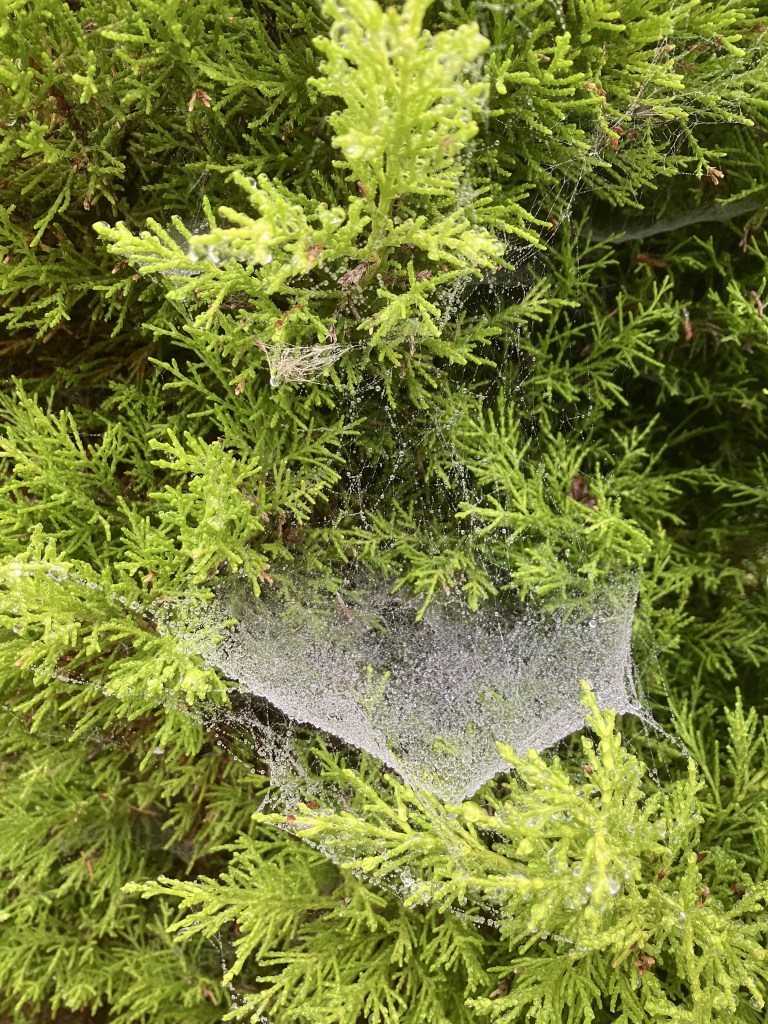
As an amateur photographer, I find the tiny rain droplets on grass blades, leaves, and petals so fascinating. In different light conditions, they look like jewels. Then there are the intricate spider web patterns revealed by the droplets, glistening like a finely crafted diamond necklace or lace. We often overlook these web designs, only for them to be revealed as complex works of art revealed by the rain. Below is a photograph of an exquisite example of this.
Reflecting on the Rain
Not coincidently then, water in the Quran is mentioned as being sent down from on high. For example in Surah Al-Baqarah,
وَأَنْزَلَ مِنَ السَّمَاءِ مَاءً فَأَخْرَجَ بِهِ مِنَ الثَّمَرَاتِ رِزْقًا لَكُمْ فَلَا تَجْعَلُوا لِلَّهِ أَنْدَادًا وَأَنْتُمْ تَعْلَمُونَ (2:22)
…and sent down from the sky, rain and brought forth thereby fruits as provision for you. So do not attribute to Allah equals while you know
And
(2:164) وَمَا أَنْزَلَ اللَّهُ مِنَ السَّمَاءِ مِنْ مَاءٍ فَأَحْيَا بِهِ الْأَرْضَ بَعْدَ مَوْتِهَا…لِقَوْمٍ يَعْقِلُونَ
…and what Allah has sent down from the heavens of rain, giving life thereby to the earth after its lifelessness…for a people who use reason
And in Sahih Muslim3, there was a beautiful narration by Anas Bin Malik about the Prophet Muhammad, peace and blessings be upon him (s.a.w.), and rain:
“Whilst we were with the Messenger of Allah ﷺ rain fell upon us. The Messenger then exposed part of his garment so that rain fell on his body. When we asked him why he did so, he replied “Because it has just come from the Exalted Lord”.
From the above verses and narration of the Prophet s.a.w., the concept of rain is very much tied to the Divine Grace and Mercy as water is not only essential to life but is also life giving. The verses above affirm the life giving ability of water as it is the necessary element by which the “growth of all things” and “fruits” as well as water’s enduring nature of “giving life thereby to the earth after its lifelessness” are made possible.
The necessary reciprocal to this Divine Grace and Mercy is gratitude. In fact gratitude is a key concept in the Islamic ethical framework, not only to the Most Gracious but also to the creation of the Most Gracious as mentioned in Sunan Abi Dawud4, as narrated by Abi Hurayrah that the Prophet (ﷺ) said: He who does not thank the people is not thankful to Allah. Gratitude in Islamic concept is not just a feeling but necessitate action that is founded in mercy and justice in order to maintain or restore balance.
What does being grateful to and for creation, in this case rain, looks like? For me, firstly being grateful means that I should find joy in the rainfall. There is a simple joy in my experiencing the rain that I know other creatures share. After the rain, I often observe the birds enjoying the puddles as they bathed themselves and of course, the busy insects hovering over the tiny droplets of water on the blades of grass, the leaves or even on the spider webs, much to the delight of the spiders. I too enjoy puddles, even now as an adult, skipping over them, or jumping into them and making a splash. I find it perplexing how often people complain about the rain or take the rain for granted.
The second act of being grateful is to understand that every creature has a right over the rain water sent down by God and so I must ensure the fair distribution of that water in the land for all creatures. That is why I am very disturbed when so much water is wasted – from individuals, corporates, and even the urban infrastructure. From my observation, so much of the urban environment is paved that rain just does not penetrate into the ground underneath but is instead chanelled into the drains and sewage. Even when the ground is not paved, the land is unable to adsorb the water because of the poor quality of the soil. This means that the water catchment areas that feed streams and rivers get less water to store in preparation for the drier seasons.
That understanding of the need to distribute the water fairly means I need to step up to the plate to help restore the balance. For me, this means getting involved in conservative efforts such as a community garden and battling my factor5 about the over-zealous cutting of the grass on the grounds of my neighbourhood among other things. Om a personal level, I created several mini ponds and water fountain for the wild life in my garden, fed from rain water. Below is a video that I took of my neighbour’s cat exploring the water fountain in my front garden.
Practice Session
As mentioned in my post, ‘Framing the Project Part 2,’ the following are some of the techniques you can use to build your connection with nature based on the three principles.
- being still
- observe
- reflect
Being Still
To begin, I recommend finding a spot where you are most comfortable. This could be indoors or outdoors. My preference is outdoors, in my little garden, under the apple tree. But being indoors and dry might be preferable to you. Whatever your preference, do find a good spot where you can clearly experience the rain. If outdoors, make sure you are able to keep warm. Stand, sit, or lie down as you wish as long as you are comfortable and able to keep still and silent for long moments. Silence is more important than pure stillness in this case, especially for children who might find it difficult to keep still. I also encourage having a small notebook to jot down what you observe rather than using the phone or other gadgets to start with as the tech can be a distraction.
Observe with your senses
Next, choose a sense that you want to practice with first. Once you have practised with one sense, you add on another until you are observing with all your senses. As you start to expand your observation of not only the rain but also of the surrounding and its effects on you, you will build an intuitive awareness of the various reactions to rain and its connection to yourself and your surroundings too. Let’s explore a few of these senses together.
Sense of smell
If you are indoors, try to open a window so you can smell the rain. Describe the scent(s) in your journal. Observe too if the smell changes over the duration of the rain. Is it more pronounced at one point or another? Write down these observations.
Try to notice what accompanies the scent(s). Is there something nearby that is influencing the smell? For example, a plant upwind from you might change the smell of the rain on that occasion. So identify your surroundings each time you encounter a smell while observing the rain.
Also, do different types of rain have different smells for you? As you repeat the practice, you might find there are subtle differences in smell of different kinds of rain.
Ask yourself what these smells trigger in you? What do you associate with these scents? Record your feelings and body reactions to these scents.
Sense of hearing
If you’re more sensitive to sound, then settle down in your spot and observe the rhythm of the rain. Again write your observations in your journal.
What are the different types of sounds that you can hear just before, during, and after the rain? How do different locations and surroundings change the sound of the rain?
What about the absence of sounds? Are there sounds that suddenly become silent?
Observe the effect of these sounds, or lack of them, on yourself. Is it soothing or scary?
Sense of sight
Similarly with the sense of sight; what do you see in the sky, in your surrounding that changes as the rain starts? How does the sky change through the rain cycle?
What types of clouds are associated with certain types of rain?
What happens to the raindrops when they land on different surfaces?
How do the plants, animals, and humans respond to the rain?
Sense of touch
As for the sense of touch, it is best to be outside and experience the rain. Lift your face or reach your hand out to the rain. How do the droplets feel as they touch you? Warm, cold?
Are they furiously fast and hard hitting or gentle and light?
From which direction do the raindrops come; directly above, north, south?
How does your surroundings affect the impact of the droplets on you?
How does the rain sensation make you feel?
Reflect
As I sit with/in the rain, there are questions I often ponder upon. Take the time, whether during the observation practice or after, to ponder on your own questions. Sometimes these questions can lead to others. If so, let yourself follow the paths of thought they take you on. Reflecting on them will only deepen your understanding of the interconnectedness of the natural world.
Some questions to start with:
- What is your relationship with the rain?
- Why do you feel what you feel about the rain?
- How does the rain affect you and your surrounding?
- In your own faith tradition, how is the rain portrayed and why?
An example of a question I had is based on a wee nursery rhyme in my culture that asked why the rain fell and after a long-winded story, the answer was because the frog called for it in order that it escape the snake. It’s a little ditty that is based on the observation that bull frogs tend to call out in the rain. The rhyme however often makes me ponder on who/what is asking God to send down the rain. Is it the frog, or a little bird who has to fly far to find water, or a little worm in the soil who needs the moisture, or the parched earth itself? If so, everything else benefits from the call for rain and I should be grateful not only to God, to the rain, but also to the one whose ask was granted.
- https://www.science.org/content/article/love-smell-wet-earth-after-rain-so-do-these-strange-creatures#:~:text=Springtails%20use%20the%20scent%20to%20find%20food&text=Humans%20aren’t%20the%20only,when%20soil%20conditions%20are%20poor. ↩︎
- https://elephantguide.com/en/everything-you-need-to-know-about-elephants-and-water/ ↩︎
- Sahih Muslim is one of the collections of narrations from the Prophet Muhammad, peace be upon him. ↩︎
- Sunan Abu Dawud is another in the same collections of narrations. ↩︎
- In Scotland a factor (or property manager) is a person or firm charged with superintending or managing properties and estates—sometimes where the owner or landlord is unable to or uninterested in attending to such details personally, or in tenements in which several owners of individual flats contribute to the factoring of communal areas. ↩︎


Leave a reply to Call to Action: Save Water – Treading Lightly on This Earth Cancel reply