
In this post, we will explore our connection to a superstar of nature – trees. The number of tree species in the world is estimated to be about 73,0001. In a 2015 study, they estimated there were around 3 trillion trees globally. This estimation was based on satellite imagery and forest inventories2. Yet, this number is less than 46% of the tree population when human civilisation first started over 5000 years ago.
Trees are not only vital but integral to Earth’s ecosystem. The list of their contributions below is just a drop in the overall functions they play. Trees:
- house, host, and feed other creatures like the micro-organisms, fungi, insects, mammals, birds, and other plants,
- regulate the level of gases in the air by producing oxygen and removing carbon dioxide in the daylight and vice versa at night,
- reduce air pollution by adsorbing particulate matters,
- regulate the temperature of its surrounding by providing shade and cooling down the air by releasing water molecules through evapo-transpiration,
- increase cloud formation and rainfall through evapo-transpiration, thus restoring the balance in the water cycle,
- stabilise soil and prevent soil erosion.
Unfortunately, in many urban environments, there is a distinct lack of trees. This is why cities are often hotter and more polluted than rural areas. I have been very fortunate to have grown up in Singapore. It is a city with nearly 30% of its area covered by trees. Now, living in the outskirts of Edinburgh, I am surrounded by trees. However, most of the other big cities are not as fortunate.
Engaging the senses
My first relationship with a tree was not only in a physical sense. It was more about companionship. Visiting the rain tree at the bottom of my school field, I could sense its loneliness. Trees are not meant to be alone. Usually there would be others of its species nearby or even other tree species. However, this tree stood alone at the bottom of the field.
Communication
I don’t know how to describe how I sensed the rain tree’s loneliness. The ability is not based on my normal physical senses. Perhaps because trees can communicate3, they can also communicate with us but we don’t normally understand that communication.
For me, I can often sense how a tree is feeling. For example, a few summers ago, the row of lime trees in front of my house were really stressed because of the dry summer. However, my apple and cherry trees, as well as my neighbour’s apple tree, were quite happy with the heat. This summer, all the trees seem to be quite content. I do not think it is me projecting my feelings. I cannot relate to my own feelings.
I also talk to trees, in fact, I talk to all the plants and living creatures I encounter. It may sound barmy but they do respond in their own ways. There are times when I am in my kitchen, looking out into the garden and I can sense my trees calling me to join them. Just a few mornings ago, I looked out and sensed them saying they felt neglected. They wanted me with them even though there is nothing much I can do for them. Similarly, the trees outside my house tend to greet me at times. They catch my attention with a wave of a branch. Sometimes, it’s just a whisper or rustle of the leaves.
The rain tree of my childhood leaves an indelible mark on me. Among all the trees I’ve encountered over the years, it still stands out. Tall and resolute, it taught me to withstand pressures against compromise. No matter what the weather threw at it, it kept providing me with shade. It offered cover whether I sat or stood under its branches. It taught me the wisdom of growing old gracefully while alone. It also taught me to nourish all the other creatures dependent on it. This is a lesson I will value throughout my life.
Tactile sense
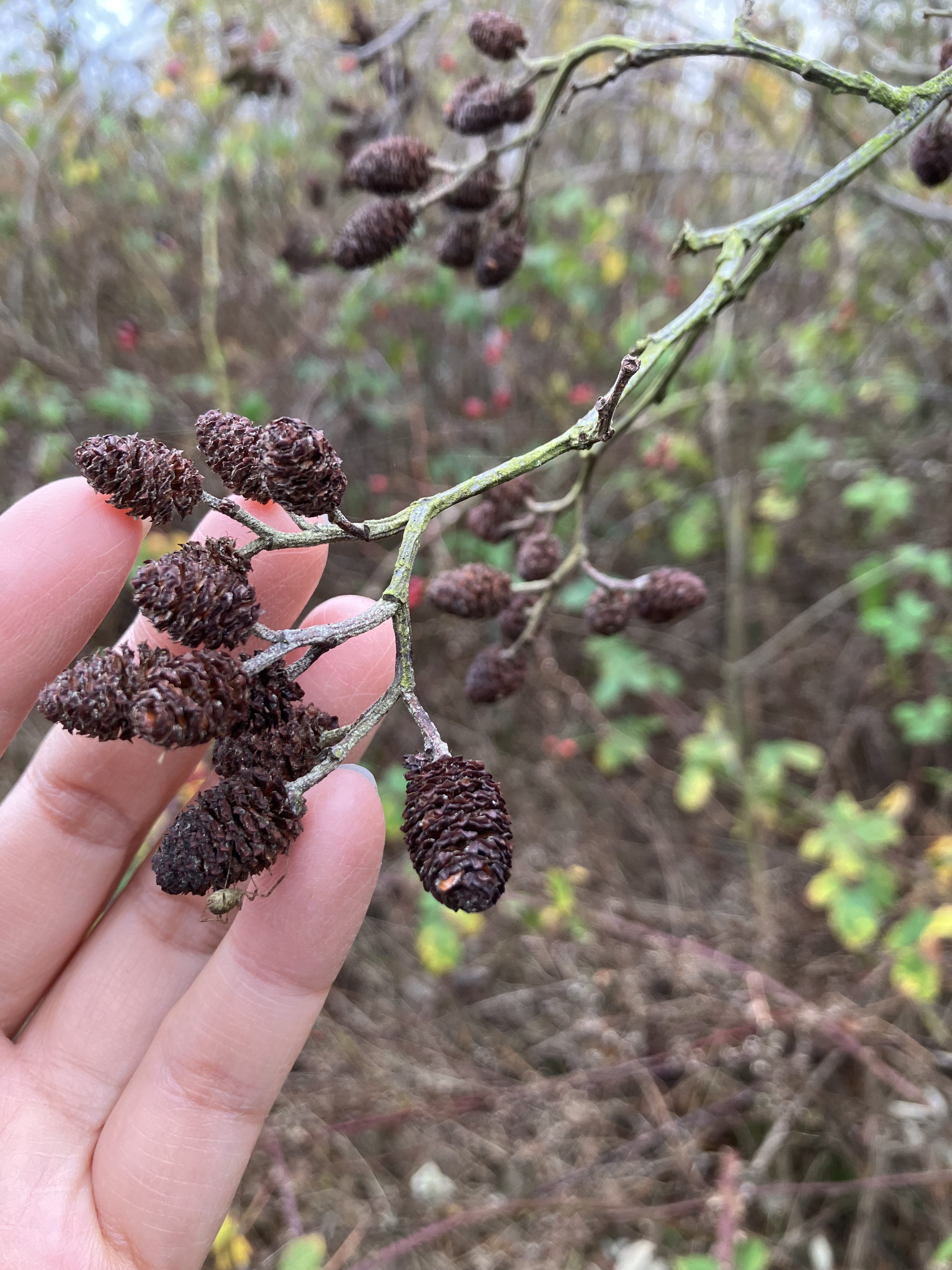
Trees are tactile creatures who often invite me to caress them whenever I walk among them. The scars on their bark or trunk call out to me. A low hanging branch, a buttress root, and a falling leaf also invite me to touch and experience them. I enjoy the feel of the various textures. Below is a photo of the low hanging fruits of a birch4 tree. They feel quite rough and dry. This is unlike the paper-like bark of the paper birch tree. An eagle-eyed reader might spot the spider in the photo.
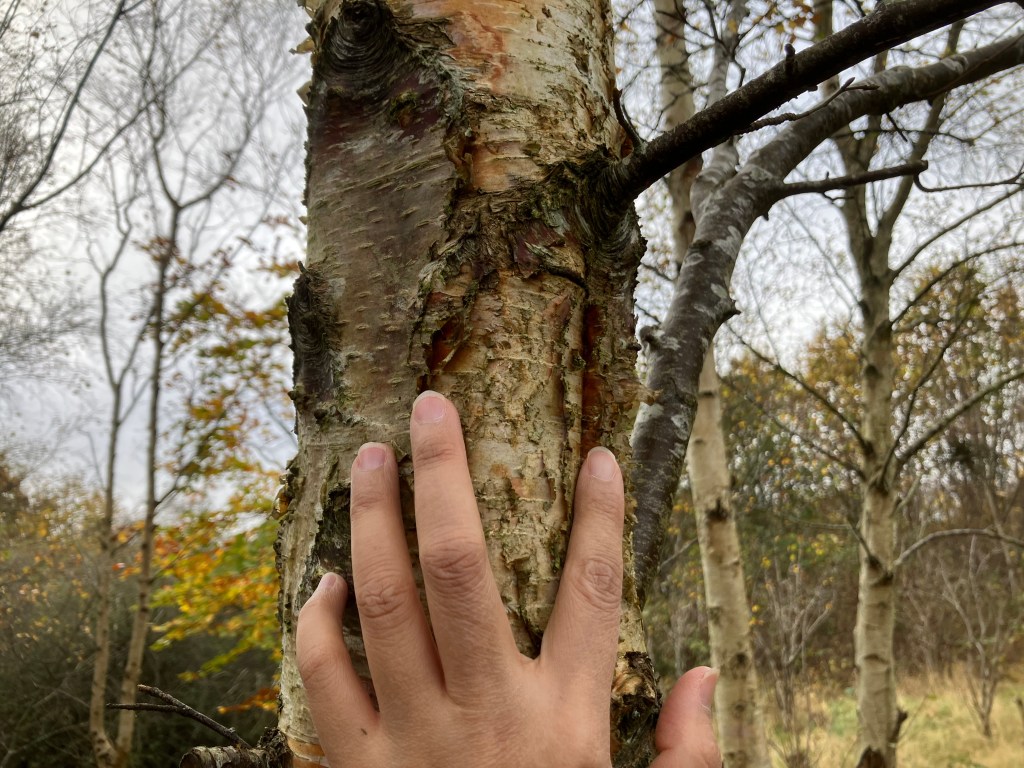
Of the many parts of the tree, the tree bark fascinates me the most. The bark is the most expressive part of the tree. It shows the world who it is. The bark displays the conditions it had faced through time. It faces these conditions proudly and unapologetically. I touched the silver tree bark below. I was fascinated to feel the different textures of the new versus old bark. I traced the ‘scars’ and remembered how resilient it is as it stood exposed to the elements.
Sight
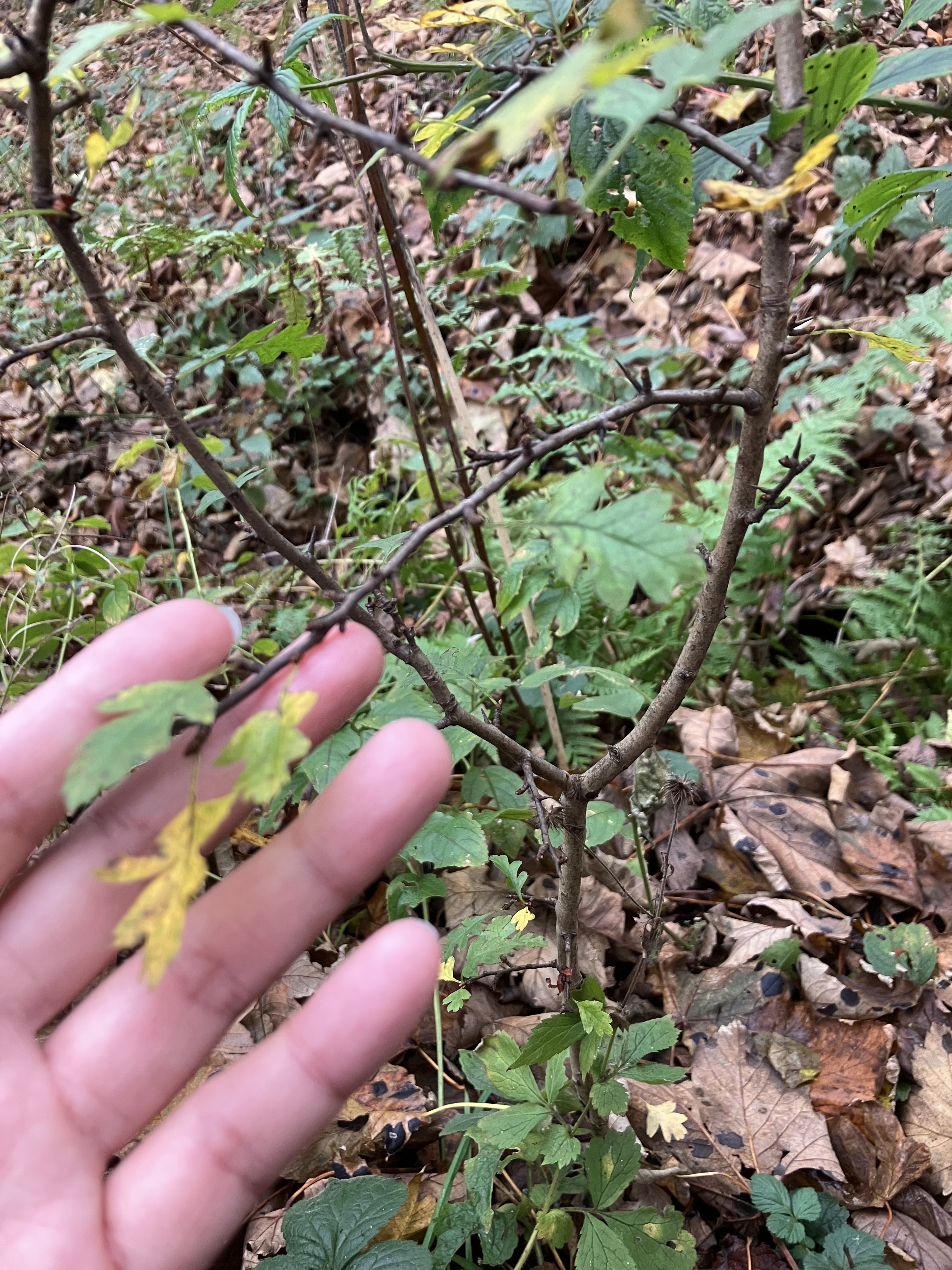
I love watching trees in winter with their bare branches because I can see the fractal patterns very clearly. Fractals are infinitely complex patterns that are self-similar across different scales. The photo below illustrates what I mean. The larger branches sprout out smaller branches. These, in turn, produce even smaller ones.
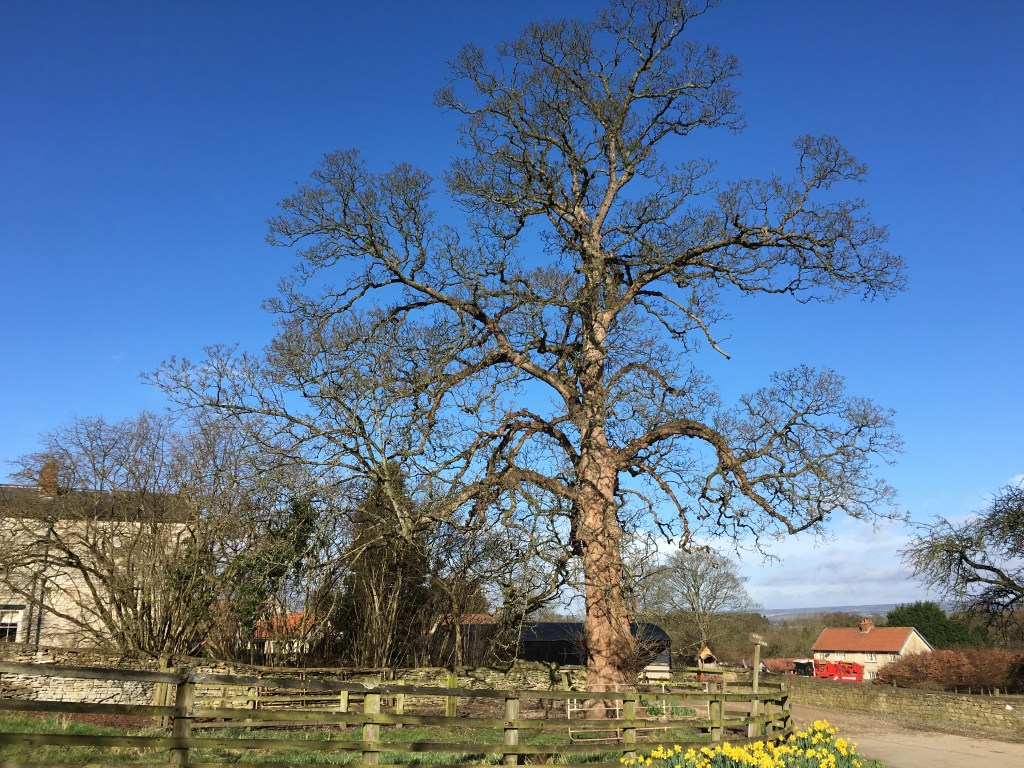
The same fractal patterns can also be observed in the roots – as above so below. These patterns show that there is an order and complexity within what looks like chaos. They imply that there is a purpose to the way trees are created. One such purpose in the fractal way that the branches grow is to maximise the area in which its leaves can adsorb sunlight.
I was reading the book ‘The Natural Navigator’ by Tristan Gooley which mentions that trees in the northern hemisphere tend to grow out their branches towards the south, i.e. towards the light, and the branches facing the north tend to grow more vertically. I’ve noticed this effect with my apple tree. Its branches tend to grow more towards the East and South East or South West. This is because that is where the sunlight tends to be most abundant.
Another thing I noticed when I first lived in a seasonal country are the budding leaves. In tropical countries or with ‘evergreen’ trees, the budding leaves are not as noticeable. The plant life in the tropics are almost always budding in the regular alternation of rain and sun. On the other hand, in a seasonal climate, it is an incredible sight to track how buds start forming in autumn just as dried leaves fall away. Then, the buds stay dormant in winter. They only unfurl in spring to form small light green leaves. As the season continues into summer, these leaves grow larger and greener. In the autumn, they turn yellow, brown, or red. The leaves eventually dry and fall off, completing the cycle. It is such a beautiful process to observe.
Smell
Most of us have had experiences with essential oils. Essential oils are actually extracted from the fragrant parts of plants like the flowers, leaves, bark etc. I often find essential oils too strong and prefer the actual fragrance from those parts of the tree themselves. For example, to me the pine scent from some of the cleaning solutions can be overpowering. However, whenever I walk underneath the Scottish Pines dotted around my neighbourhood, the natural aroma of the pine needles is really subtle and refreshing.
As I mentioned in my post on the rain, the tree leaves give off their own delicate scents, especially in the rain. I notice it more in Autumn when the leaves dry up and fall to the ground, only to be stepped on and thus releasing the fragrance. While not strictly a tree, I used to have a couple of lavender bushes at the front entrance of my house and whenever I brush past the leaves and stalks, I catch the scent of lavender which then lingers on my clothes for a while. I cut and dry the lavender stalk, leaves, and flowers in the summer indoors such that the house smells of lavender throughout the season and beyond.
Sounds
Have you ever stepped on a dried leaf and noticed the crunch? It’s one of my favourite things to do when walking. I remember when I was young, I would always keep a lookout for dried leaves on the pathways. In Singapore, where most trees are evergreen, these dried leaves are a rare sight and one to be cherished. So living in Edinburgh where dried leaves in Autumn are abundant, I tend to indulge in my favourite past time and once managed to record myself crunching the leaves underfoot as I walked along the Water of Leith. Below you can find the sound recording. There is something really satisfying about the crunching sound.
I also enjoy listening to the creaking of the branches and rustling of leaves. Like many things in nature, there is a musical quality to these sounds that soothes the soul. Sometimes they are sharp and staccato like that one time I heard a loud groan breaking the silence in the woods only to realise that it was the movement of a large tree branch a couple of meters away from me. Other times, they come to me like the whisperings of God’s beautiful names, rocking me into a more meditative and contemplative state.
Combining the senses
It is a privilege and an honour to be invited to sit in an exalted gathering of trees and their entourage. Those moments I have been in such companies, I have felt peace and acceptance. The coolness pervades even on a hot sunny day and I am surrounded by the quiet melody of gentle rustling leaves and woodsy aroma, calming my senses. Looking up, I can see the dappled sunlight filtering through bright green leaves and criss-crossing branches. In these moments, I see God’s Grace and Beauty in my surroundings. That is exactly the purpose of such gatherings to me. I think that the gatherings of trees are, in essence, magnifying the glorification of God that each individual tree does on its own in all circumstances. In turn, this act of glorification instills peace and tranquility in me. Her description of my thoughts is so much more profound.
Reflecting on trees
A few days ago, I went walking in the woods near my home and admired the trees which were a mixture of various types of broad leaf and Scottish pine. There were many large trees that shaded me as I climbed the hilly pathways, aided by the criss-crossing of their roots. The birds and squirrels happily flitted between the branches soaring above me. The leaves rustled in the wind as if sharing stories to one another and the sound of the stream could be heard in the distance. Below is a video I took on the walk by the stream and among the surrounding trees.
As I walked, I was struck how the experience evoked these words from Surah Ibrahim:
بِسۡمِ ٱللهِ ٱلرَّحۡمَـٰنِ ٱلرَّحِيمِ
أَلَمۡ تَرَ كَيۡفَ ضَرَبَ ٱللَّهُ مَثَلاً۬ كَلِمَةً۬ طَيِّبَةً۬ كَشَجَرَةٍ۬ طَيِّبَةٍ أَصۡلُهَا ثَابِتٌ۬ وَفَرۡعُهَا فِى ٱلسَّمَآءِ (٢٤) تُؤۡتِىٓ أُڪُلَهَا كُلَّ حِينِۭ بِإِذۡنِ رَبِّهَاۗ وَيَضۡرِبُ ٱللَّهُ ٱلۡأَمۡثَالَ لِلنَّاسِ لَعَلَّهُمۡ يَتَذَڪَّرُونَ (٢٥) وَمَثَلُ كَلِمَةٍ خَبِيثَةٍ۬ كَشَجَرَةٍ خَبِيثَةٍ ٱجۡتُثَّتۡ مِن فَوۡقِ ٱلۡأَرۡضِ مَا لَهَا مِن قَرَارٍ۬ (٢٦)
“Do they not see how Allah sets forth a parable of a good word? [It is] like a good tree, its roots firm, and its branches [stretching] to the sky. Giving its fruits all the time by its Lord’s permission. And Allah sets forth parables for mankind so that they might reflect. And the parable of an corrupt/rotten word like a rotten tree, uprooted onto the surface of the earth, without any stability”
Of course, the first question that came to me was ‘How is a word like a tree?’ There are of course different exegesis on these verses but let me share my reflections on the words above.
Nature of trees
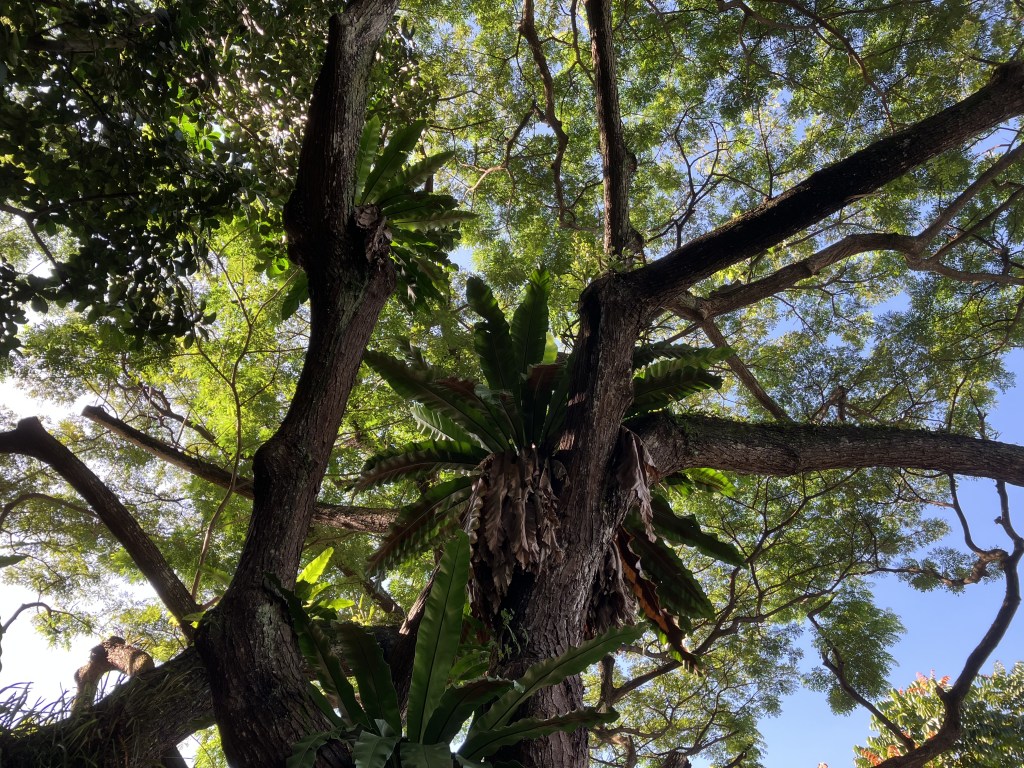
Before we can understand how a word and a tree are alike, we need to know more about the tree. I have a soft spot for trees especially the rain tree beneath which I spent much of my free time in school and adsorbed much of its wisdom. While the photo below is not of my beloved rain tree, it is a rain tree, one of many that can be found in Singapore. As you can see in the photo, the tree is home to ferns among other creatures such as moss, insects and birds.
The natural life span of the rain tree is about 80-100 years which is pretty short. The oldest tree in the world at over 4800 years old. In the British Isles, the yew, oak, and sweet chestnut are among the longest lived at almost 1000 years. The older the tree, the more complex their mycorrhizal network which help support their seedlings and other trees and plants. These old trees are called the ‘Mother Trees’.5 But however long their natural lifespans are, all trees contribute towards the balance of nature as mentioned at the top of the blog, a life of dedicated service that extends even after death.
Take the example of an oak tree; it has evolved such that there are native fungi, plants, micro-organisms, and animals that are dependent on it for food, shelter, and it shapes its habitat. In fact, a single oak can support more than 2,300 species6. The older it gets, the more species it can support and every part of the tree is important. Its flowers are a great source of food for insects, bees, squirrels among others. Of course, its fruit – the acorn – is a favourite of not only squirrels but other mammals and birds too.
Its leaves are a source of food for many types of caterpillar, some of which feed only on oak. The crevices and cracks in its bark host all sorts of mosses, lichens, invertebrates, and birds. At its roots, mycorrhizal fungi develop, some of which are specific to the oak tree. Then as it dies, birds such as the woodpecker and owls, and bats, and squirrels use the cavities left behind as their homes.
Even when trees fall or get uprooted and die, they still benefit their surroundings. The decaying tree becomes host to many different fungi, bacteria, and insects. As the tree decomposes, the soil gets enriched and the nutrients are used to nurture other plants and trees.
A word is like a tree
Such is the nature of a tree, that it is beneficial to its surroundings through out its life. Reflecting on the Qur’anic verse that a good word is like a good tree, I think about the nature of words. A word is the culmination of translating thought into verbal action and thus a ‘fruit’ which disseminates its seeds, the ideas and concepts, into the fertile grounds of other minds. These ideas then take root and give birth to movements that change the world.
We’ve seen positive words sparking movements in history like the anti-colonial/fight for independence in Africa and Asia like the ones led by Ghandi in India or Omar Muktar in Libya, anti-slavery movements of the 1700s-1800s, anti-war movement of the 70s led by the peace activists, and climate justice movement of the recent years led by activists in Extinct Rebellion and the likes. Most recently is the anti-genocide movement raising their voices globally on what is happening in Gaza. Like trees, they grow organically and bring together a community of like-minded people. The community is nurtured by the common vision/cause and draws strength from each other. While each may take different courses of actions, cummulatively these actions help bring about change and they are all driven by the power of words.
Even when the words are negative and have negative effects, we often see that what seemed to be dark days often give way to positive outcomes which outlasts those dark days. I remember how the Bosnian genocide was a difficult period but it was relatively short when compared to the peaceful period, however fragile it is, since then and that there are many positive outcomes from that horror. For example, not only have the Bosnians rebuild their cities and land, the global Muslim community has actually reconnected with a lost part of their history. Before the genocide, most Muslims did not even know that there are fellow Muslims in the Balkan states. I was one such Muslim and got to know a few Bosnian Muslims who were refugees during the genocide.
To bring the notion of a word is like a tree into an individual context, this project was sparked by the words in the Qur’an – on ‘walking gently (and humbly) on the earth.’ The idea sparked by these words has stayed dormant in my head for a long time, like a seed in the dark earth, waiting for the right time and conditions to germinate. That time and conditions came through the umbrella project as mentioned in the About Page. The project is still a seedling at the moment but it is my hope that by God’s will, it will grow into a strong tree through your participation, dear readers.
Practice Session
As mentioned in my post, ‘Framing the Project Part 2,’ the following are some of the techniques you can use to build your connection with nature based on the three principles which I reiterate:
- being still
- observe
- reflect
Being Still
I invite you to find a tree that you feel welcomed by. You will know if the tree welcomes you by feeling drawn to it. Give it the greeting of peace and ask its permission to sit or stand beside or beneath it. Treat it as you would treat an honoured host. For some, it may be difficult to find a tree or even be outdoors. In such cases, I recommend to find a plant to sit with. For example, there are ferns, spider plants, or miniature trees that can be grown indoors.
Stand, sit, or lie down as you wish as long as you are comfortable and able to keep silent. I also encourage having a small notebook to jot down what you observe rather than use the phone or other gadgets to express your thoughts as the tech can be a distraction. Enjoy the silence and stillness and observe how your senses react. Do they calm down or are they invigorated? Which of your senses react the most? Take note of these observations in your notebook.
Observe with your senses
Next, choose a sense that you want to practise with first. Once you have become practiced with one sense, you can add on another. Continue this process until you are observing with all your senses. As you begin to expand your observation of the tree and its effects on you, you will develop an intuitive awareness of your various reactions. You will also notice its connection to yourself and your surroundings. Let’s explore a few of these senses together.
Sense of sight
Describe the tree in your journal. Be specific in all the details you observe with your sight.
What about the tree that caught your eyes? Is it the height or the size or perhaps certain features? Which part of the tree draws your attention the most? Take note of this and as you repeat the practice, observe if your answer stays the same or does it change every time you approach it in subsequent visits?
What is unique about the shape or colour of its leaves? The shape of the leaves can often help you identify the species the tree belong to. If you are interested to learn further, there are several books and internet articles that can help. How do the leaves change through the seasons if you’re doing this practice over a long period?
What do you see in the vicinity of the tree? Are there moss or fungi growing on the trunks? Lichens on the branches? What about insects? Do you notice movements overhead in your peripheral vision? Jot down these observations in your journal.
Can you spot something new everytime you visit the tree?
Sense of touch
Trees are tactile beings as I mentioned so explore your relationship with the tree through touch. How do the different parts of the tree feel to you? Is there a texture that fascinates you? If so, why does it draw your interest? How do these textures affect you? Do they influence your feelings and/or mood? Write these observations and answers in your journal.
Sense of smell
Scents are more subtle with trees and not many people can really smell the unique scent of a tree species. Try to observe the difference in the aroma near the tree as opposed to when you are away from the tree. Do you detect any differences?
Crush a leaf and smell the scent. What do you smell? Or if there are flowers, try smelling those.
Sense of movement
As a dyspraxic, I do not climb trees unless the branches are low. But I would urge you to try to climb the tree if possible. How does climbing a tree change your sense of balance and coordination? How is it different from climbing other things e.g. rock climbing?
Reflect
As I sit under the tree/s, there are questions I often ponder upon. Take the time, whether during the observation practice or after, to ponder on your own questions. Sometimes these questions can lead to others. If so, let yourself follow the paths of thought they take you on. Reflecting on them will only deepen your understanding of the interconnectedness of the natural world with yourself.
Some questions to start with:
- What is your relationship with the tree?
- Why do you feel what you feel about the tree?
- How does the tree affect you and your surrounding?
- In your own faith tradition, how is the tree portrayed and why?
- What impact, if any, do you have on the tree and why?
An example of a question I ponder upon is how I serve the trees. This question arises given all of the services they provide. Gratitude requires action. What actions have I taken to show my gratitude for the bounties my fellow tree companions have given me?
- https://www.pnas.org/doi/10.1073/pnas.2115329119#:~:text=Our%20results%20indicate%20that%20there,species%20are%20in%20South%20America. ↩︎
- https://news.yale.edu/2015/09/02/seeing-forest-and-trees-all-3-trillion-them ↩︎
- https://onetreeplanted.org/blogs/stories/how-do-trees-communicate#:~:text=Through%20these%20networks%2C%20trees%20can,detect%20a%20bee’s%20wing%20beats. ↩︎
- I was unable to identify the actual species. ↩︎
- https://howtorewild.co.uk/magazine/what-are-mother-trees-and-master-trees/ ↩︎
- https://www.sugiproject.com/blog/oak-trees ↩︎


Leave a reply to Ramadhan Series: Reflecting on the two Signs (Nature and the Qur’an) – Mountains – Treading Lightly on This Earth Cancel reply