
In continuing this series of posts from previous months, we focus on our connection with different places and time. Previously I wrote about connecting with nature in terms of time as set by the sun and moon. You can read about it in this link. In this post, I want to explore time as experienced by us, i.e. the stages of our lives.
In each stage of life, at every moment, there is a gift of beauty if only we appreciate it. Our connection with nature in terms of our life rhythm can yield much wisdom and beauty. By life rhythm, I mean where we are in terms of our
- age
- health
- wealth
- free time
The list reminds me of a hadith (i.e. sayings) of the Prophet s.a.w.
Ibn Abbas reported: The Messenger of Allah, peace and blessings be upon him, said, “Take advantage of five before five: your youth before your old age, your health before your illness, your riches before your poverty, your free time before your work, and your life before your death.”
Source: Shu’ab al-Imān lil-Bayhaqī 10250
In this post, as part of the 4 key principles of
- silence/stillness
- observation
- reflection
- action
we will explore some of my reflections. I urge you to also reflect on your own life rhythms and wisdom you can derive from them. We will also discuss actions we can take to nurture our bond with nature at every stage of our lives.
Age
Recently, I watched an interview done with Tun Dr Mahathir Mohamad, ex-Prime Minister of Malaysia who celebrated his 100th birthday. And there are plenty of centenarians who are just as fit. But I also remember my late cousin who died in his twenties. Death comes for us at any age so we shouldn’t waste our limited time in building the connection to nature.
The younger we are, the easier it is to have a rapport with nature. Children are great explorers and always curious. This is a great age to introduce them to the natural environment. Climbing, touching, running, and even quiet observation – let them be free to experiment. I remember learning about shadows through playing shadow puppets with my dad at age 3. And running in the padi fields, covered in mud, and having leaches on my legs at age 5. And discovering the various bark textures and patterns in primary school science classroom.
We need to encourage our children to stay connected with nature and not inhibit their creativity and curiosity. Several years ago, and it feels like a lifetime, I participated in a community event. I conducted a simple experiment with the kids – how to make a volcano at home using baking soda and vinegar. They were so excited to see the ‘eruption’ and wanted to try for themselves. A lot of mess but definitely worth seeing their enthusiasm.
My nephew, last year, became the youngest Singaporean to climb Mount Everest to the base camp at age 5. And then attempted to climb Mount Kinabalu later in the year. His parents supported him through both climbs, encouraging his adventurous spirit. Snippets from his trip to Mount Everest is featured in the video below, taken from Straits Times.
I remember my eldest nephew’s obsession with flowers when he was a toddler. He would demand we stop the car when he spotted flowers and we never said no. And my youngest brother’s wonder when he first saw a chicken at about the same age. Also, my neighbour’s children would stop by my rosemary bush to pick the rosemary beetles. They just love the colour of the beetles. These bouts of unrestrained curiosity and willingness to explore are also exhibited by many animals.
As we grow older, we are being programmed to be more restrained and cautious. Our parents and society put boundaries that we are not to cross. So much so, that we are hesitant to explore and experiment with our senses. Still it is never too late to break free and explore. That is exactly the reason for this blog – breaking free of the chains to embrace our place in nature. Let’s find our inner child and re-ignite our curiosity. We need to give ourselves permission not to be afraid of crossing boundaries.
Recently I walking in one of the woods and came across this tree. Being dyspraxic and afraid of heights, I rarely climb trees in my childhood. Also, my mum wouldn’t let me do it as she was afraid I would fall. On this occasion, the tree called to me and I managed to climb at least to the first branch. It was a struggle to get back down but I was chuffed at being brave enough to try.
In today’s society, the old often are seen as a burden and outlived their usefulness. If we reflect on nature, such an idea doesn’t exist. For example the oldest, most dominant female is the matriarch of the elephant family unit and have the most experience. And this is an interesting article, linked here, about old trees and how they are keystone species in the ecosystem. Keystone species are those who have a disproportionately large impact on the ecosystem. Before the modern age, human societies also reflect this appreciation of the wisdom and contribution of the elders. We need to relearn that mindset.
Health
All of nature needs good health. And what the climate catastrophe and biodiversity emergency is telling us is that the Earth is not in good health. On 11 August 2025, a wild fire broke out on Arthur’s Seat. I took a very short video of it below. The fire was still smoldering a few days later.
In England, a drought warning is in place and Scotland isn’t much better. I was up in the Cairngorms and the ground was pretty dry. The summer of 2025 is breaking records in the Northern hemisphere. As I sit here under the apple tree, Pippin is sipping from my glass of water because of the heat. It hasn’t rained in almost two weeks.
Our health is entwined with the health of the Earth. How many people have died in the Ethiopian famine in the 80s? It is still etched in my memory because of how my mother used it as an example to be grateful. And those who perished and suffered in the hurricanes. While the starvation in Gaza is due to Israel’s enforced siege, the Gazans cannot grow their own food either. All because of the destruction of the agricultural land by the bombs these two years.
On a personal note, I have been struggling for more than two months now with my arthritis. It has made me realise how I took my mobility for granted. Just like we took so much of the Earth’s health for granted and squandered it. We never seem to truly appreciate something until we lost it. But I am an optimist. If we put in the effort, the Earth can recover just as I am slowly recovering too.
I discussed some actions that we can take individually and as a collective in previous posts:
- saving water in this post linked here
- mindful consumption in the following post here
- reducing/stopping plastic waste in the post here
There are many other actions that we can take. So please make an action pledge in my action pledge page linked here.
But in line with the hadith of the Prophet above, we must take advantage of good health before bad. There is still time for us to act to reverse the Earth’s degradation as I mentioned above. I have witnessed it in many parts of Scotland where I have been volunteering.
Similarly, at a personal level, in May, I was at a better place health wise. I conducted a session for the first time to trial the 4 key principles with a few adults. God willing and health permitting, I hope to do more such sessions as part of my own pledge. I might also conduct sessions for children too. To commit to that end, I have recently attended a walk leader course. I am also working with SWAN Scotland1 to set up a SWAN walking group in Edinburgh. The first walk was yesterday where we went through the Hermitage of Braids in the beautiful autumn sun. Hopefully I will be doing such walks on a monthly basis.
Wealth
Wealth can mean so many different things, not just in the monetary sense. I interpret wealth, especially in nature, as a sense of abundance and generosity. As opposed to feeling constricted and hoarding. Nature actually embodies the concept of wealth when it gives without stint. This summer, I have been out walking with Pippin and the wild raspberries and blackberries have beckoned at me. I have given away more apples than in the past few years. But the reverse is true what with the lack of rain. The drought has reduced the grasses to stubble and caused the trees to shed their leaves. That is the holding back and of constriction found in nature.
It reminds me of the opposing names of God, ‘Al-Basit’ and ‘Al-Qabid’, found in the Qur’an, Surah Ar-Rad 13:26
ٱللَّهُ يَبۡسُطُ ٱلرِّزۡقَ لِمَن يَشَآءُ وَيَقۡدِرُۚ وَفَرِحُواْ بِٱلۡحَيَوٰةِ ٱلدُّنۡيَا وَمَا ٱلۡحَيَوٰةُ ٱلدُّنۡيَا فِى ٱلۡأَخِرَةِ إِلَّا مَتَـٰعٌ۬ (٢٦)GOD GRANTS abundant sustenance, or gives it in scant measure, unto whomever He wills; and they [who are given abundance] rejoice in the life of this world – even though, as compared with the life to come, the life of this world is nought but -a fleeting pleasure. (26)
Al-Basit is the One who grants abundantly and without stint. While Al-Qabid is the One who gives it in scant measures. My own reading of this verse is that we should not feel privileged when we have wealth. Nor should we feel unworthy if we are limited. Because both are fleeting.
Instead, we need to learn from nature and be generous and giving in times of abundance. Giving without stint just as the Earth offers us her bounties in the summer and early autumn. We shouldn’t be hoarding whatever we have, be it strength, knowledge, time, or money. Instead, these should flow unrestricted as part of our commitment to embody the Grace and Mercy of God. Part of what makes us those who tread lightly on this Earth.
In times of constriction, we should also be generous. We need to build the awareness that nothing we have been given are ours. Instead all other creation has a right to it. What ever little we have should be shared to the best of our abilities. This beautiful attribute is reflected across all of nature. Streams and rivers continue to flow as long as they can, even when there are obstructions in their way. The trees and plants continue to grow and give up as much of their yield even in drought conditions.
Time
Time here refers to free versus busy times. These ebb and flow daily and periodically throughout our lifetime. I am reminded of it because the past few months have been very hectic and life seems rushed. A couple of the participants in the session I conducted mentioned how busy they were with children and jobs.
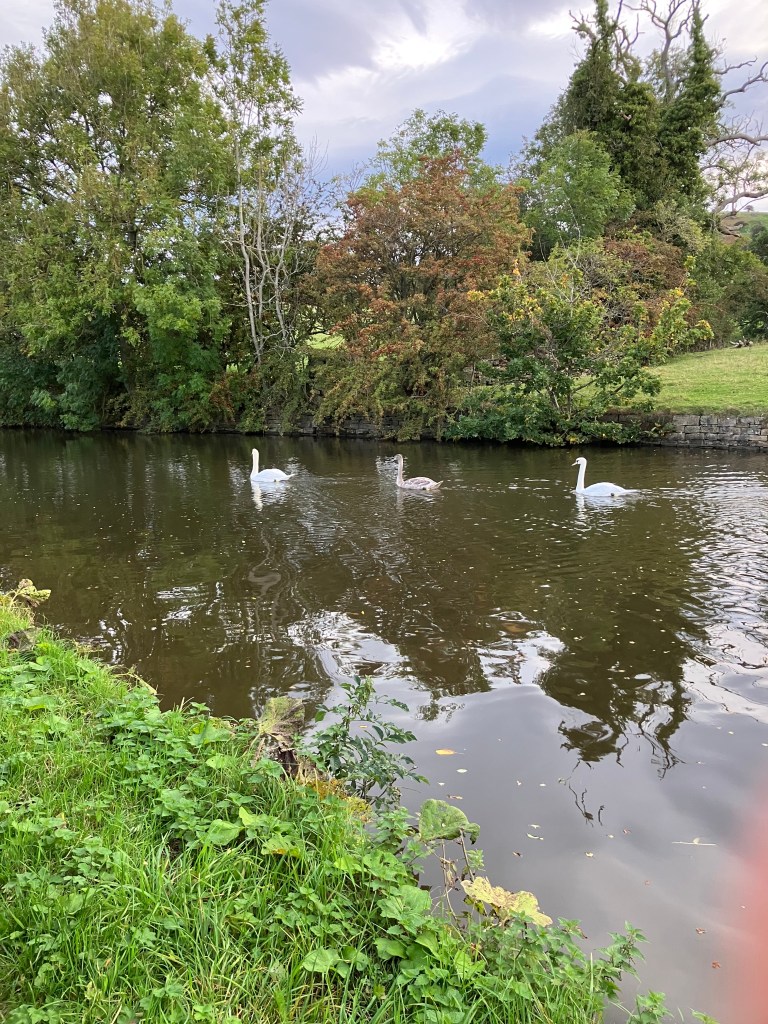
But there are times when you feel time slows down. For me, that’s when I am out walking in the hills or woods. Nature takes its own time, without any rush, and has its own rhythm. That is something as an autistic I find difficult to do on my own. Schedules and planning is how I find certainty. So being out in nature, it helps me learn to go with the flow. I can stop and watch the dance of the bees without worrying about my schedule. As they say, ‘time to smell the roses’ and so I have. I was in Skipton a few days ago and wandered along the canal. I spotted these swans pictured below. Their serenity is a wonder; no sense of having to be somewhere at a certain time or deadlines to meet.
What the above observations suggest is that our perception of time is relative to our circumstances. And a lot of our circumstances are within our control. Prioritisation is a key aspect of managing time. I will be expanding on this aspect in my next post. Till then, enjoy and make full use of the time God has given us.
- SWAN Scotland is an autistic-led Charity delivering services, information and support for and by autistic women, girls and non-binary people across Scotland since 2012. https://swanscotland.org/ ↩︎


Leave a reply to The Importance of Time: Lessons from Surah Al-Asr – on This Earth Cancel reply